

Fine Art Gallery Cardiff
The CF5 Gallery aims to encourage the love of art in everyone
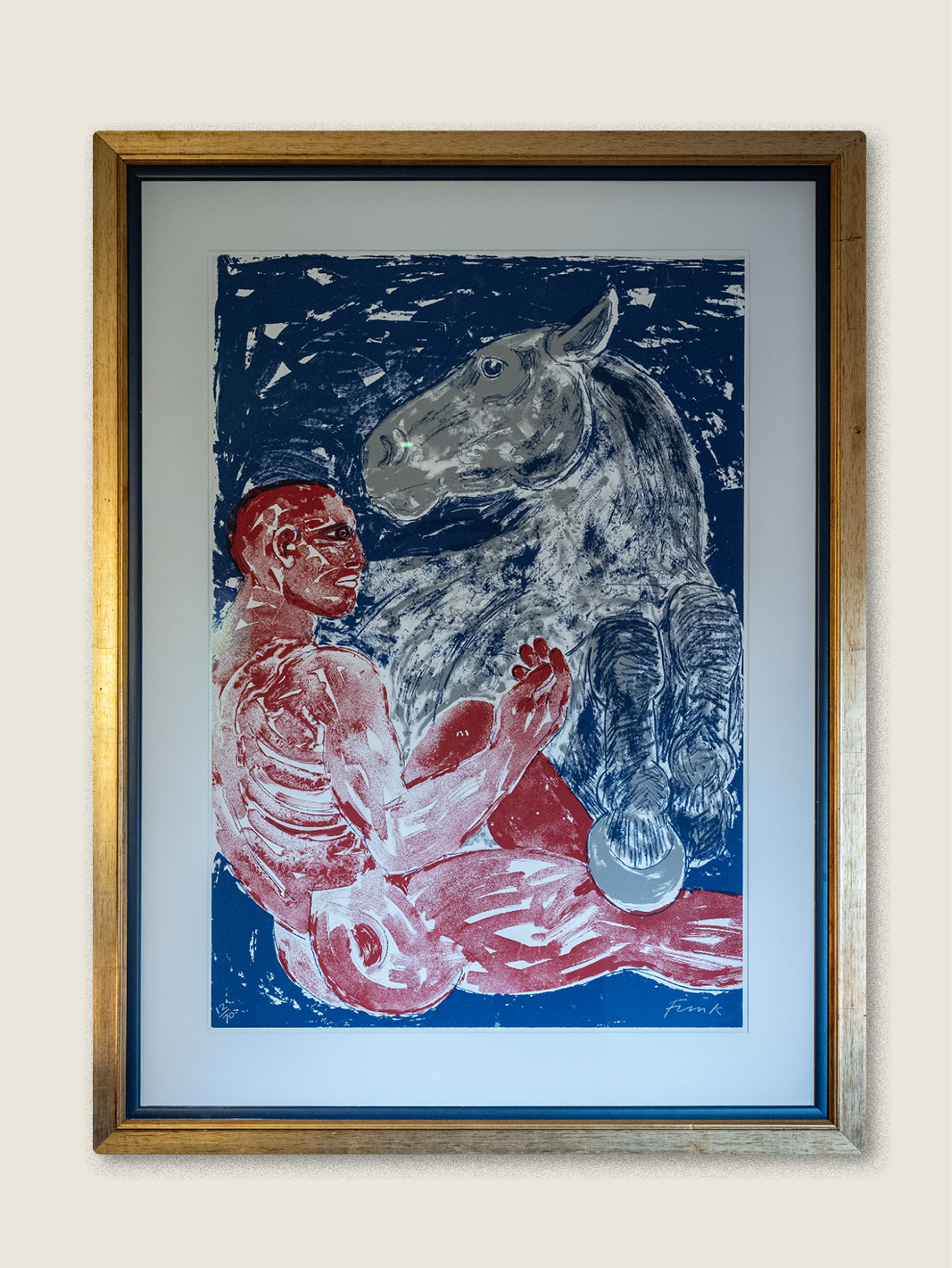
Man & Horse 1993
Original Screenprint
Signed & Numbered 12/70
Dimensions: 132cm x 100cm
DAME ELISABETH FRINK R.A. (1930-1993)
Frink was an English sculptor and printmaker. Her Times obituary noted the three essential themes in her work as "the nature of Man; the 'horseness' of horses; and the divine in human form"
Although she made many drawings and prints, she is best known for her bronze outdoor sculpture.
In the 1960s Frink's continuing fascination with the human form was evident in a series of falling figures and winged men. While living in France from 1967 to 1970, she began a series of threatening, monumental male heads, known as the goggled heads. On returning to England, she focused on the male nude, barrel-chested, with mask-like features, attenuated limbs and a pitted surface. Frink's sculpture, and her lithographs and etchings drew on archetypes expressing masculine strength, struggle and aggression. In 1984 she explained that she "focused on the male because to me he is a subtle combination of sensuality and strength with vulnerability".
Having been elected a full Academician at the Royal Academy in 1979, there were moves to make the 54-year-old sculptor the first female president of the academy, Frink however did not want the post.
Warhorse and Walking Madonna may be seen in the garden at Chatsworth House. Other work is at the Jerwood Sculpture Park at Ragley Hall. Uniquely in England, Desert Quartet (1990), Frink's penultimate sculpture, was listed at Grade II* in 2007, less than 30 years from its creation by the Department for Culture, Media and Sport. It may be seen opposite Liverpool Gardens in Worthing. Her 1975 bust of John Pope Hennessey is in the collection of the British Museum.[
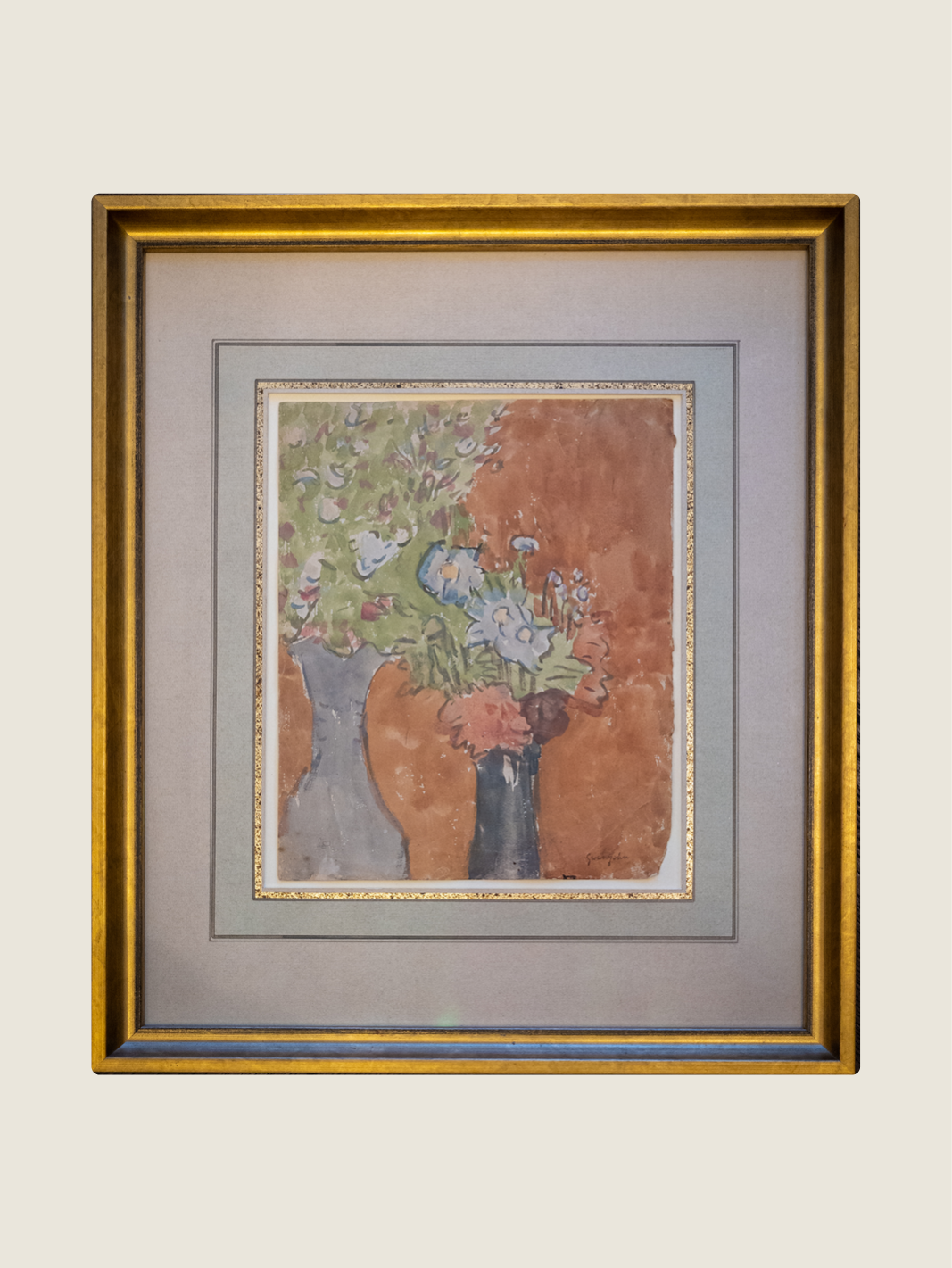
Two Vases of Flowers (circa 1920)
Gouache on Wove Paper
Dimensions: 39cm x 33cm framed
Provenance: C Langdale ‘Gwen John” - illustrated
Exhibited, Davis & Langdale, New York
Private Collection, Minnesota
* SOLD
GWEN JOHN, 1876 - 1939
Gwen John, elder sister to Augustus John, was born in Haverfordwest in south-west Wales in 1876. She studied at the Slade School alongside her brother from 1894 to 1897, she also attended Whistler’s school in Paris until 1898. Gwen John exhibited her work with major galleries, including the New English Arts Club, the Société des Artistes Français and the Salon d'Automne. She is known today as one of Britain's most important modern female painters.
She saw the world differently — quietly, attentively, and with extraordinary depth. That difference shaped everything: her subjects, her method, her colours, her words, her work.
Until June the 28th 2026 National Museum Wales will be hosting Gwen John: Strange Beauties a once-in-a-generation exhibition, bringing together rarely seen works from Amgueddfa Cymru and collections from around the world to celebrate her 150th birthday. It is the first major collection of her work in over forty years.
It tells Gwen’s story as it’s never been told before — revealing new ways of seeing her life and art and celebrating an artist whose vision still feels strikingly modern today.
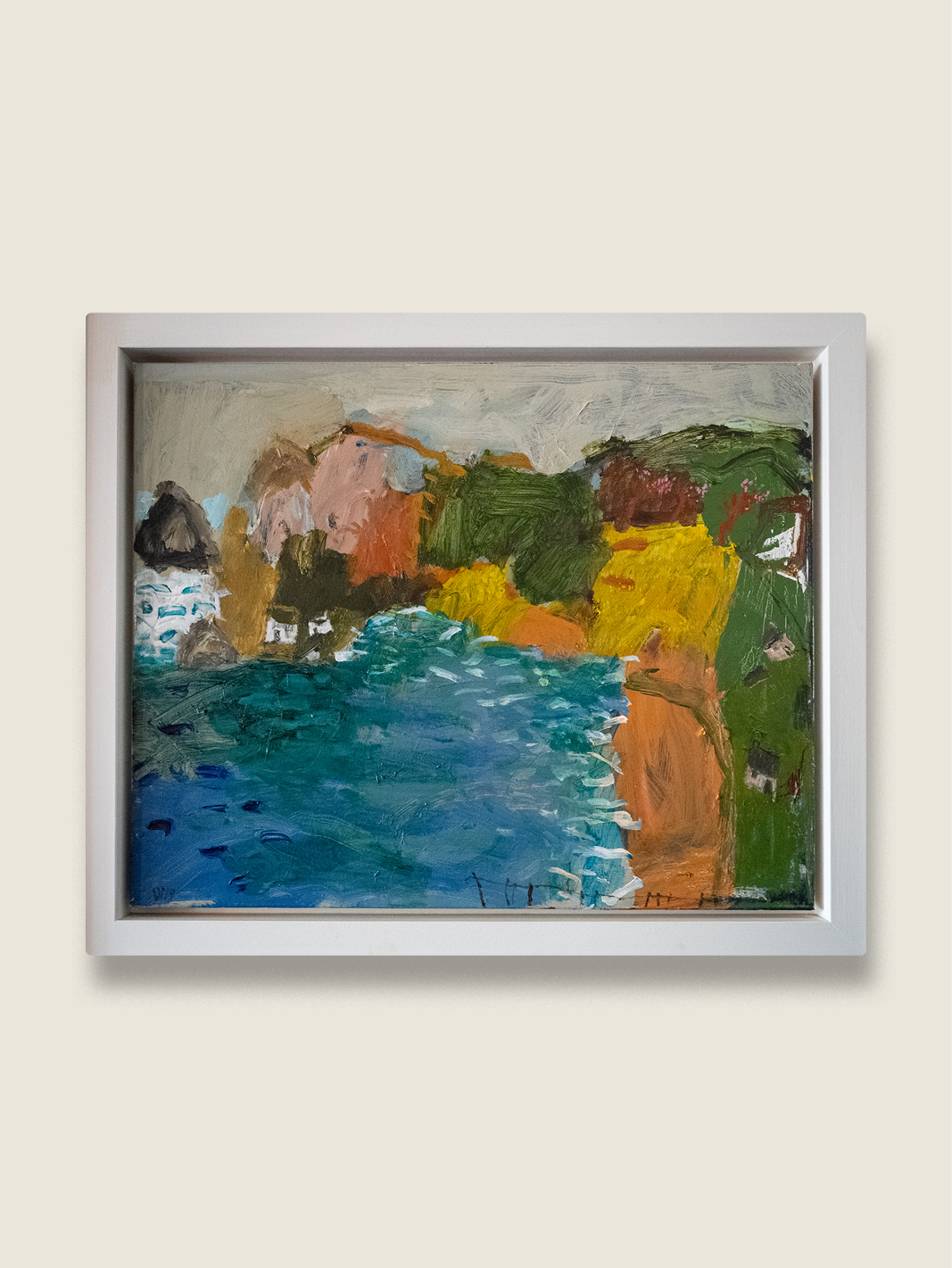
Cornish Headland
Oil on canvas
Dimensions: tbc
DAVID PEARCE 1963 -
A self-taught Cornish artist, David is based near Padstow and finds inspiration from the surrounding natural coastline. David paints in a sophisticated primitive style that is both charming and challenging at the same times.
After travelling widely throughout the 1980s, Pearce returned to settle and work near Padstow in Cornwall. As a self-taught artist, he sought inspiration from St Ives artists including Patrick Heron, Alfred Wallis and Roger Hilton in developing his primitive style. Pearce combines a naive spontaneity of composition with exciting use of colour, drawing on elements of the surrounding Cornish coastline.
"My work explores the notion of the ephemeral and the fragility of existence in both a personal and wider context. In these fast paced virtual times, I paint as it feels innate, constant, tangible. I try to work with a primitive directness, using seemingly simple compositions and just enough complexity and confusion to hold the attention. The paintings are deliberately intimate in size, with no ego or grandeur. I celebrate the innocence of awkward lines and nervous tension," The Artist, 2018
His work has been widely exhibited in Europe and the USA. Recent exhibitions include The John Moores Painting Prize (2018), The Royal Academy Summer Exhibition (2015 - 2017), "Accidental Genius" Milwaukee Art Museum (USA, 2012) and The London Art Fair (2011-2016). Between 2002-2006 his work was also featured at The Outsider Art Fair, New York.
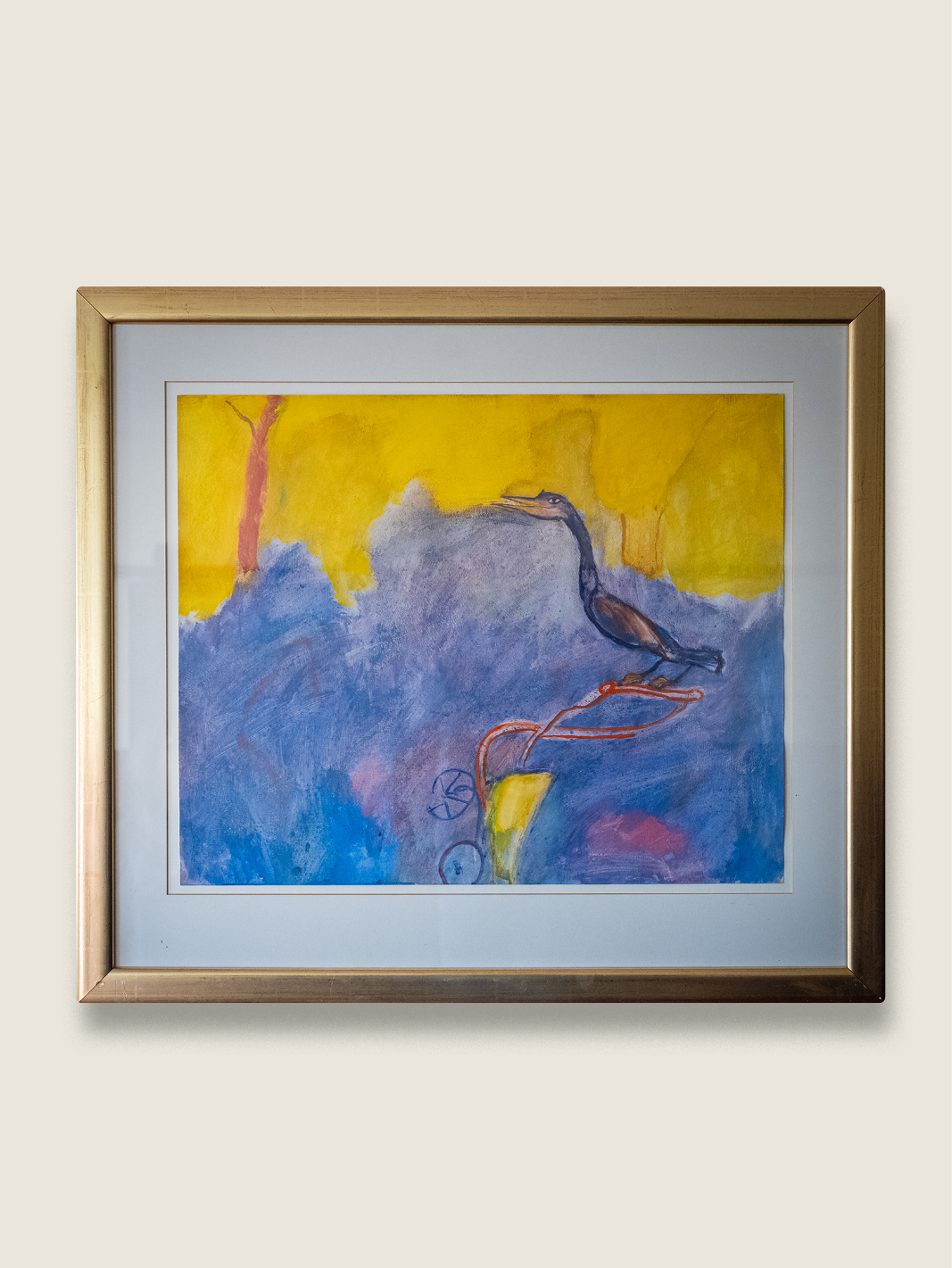
Exotic Bird
Gouache on paper
Dimensions: 79cm x 87cm framed
BEN HARTLEY 1933 - 1996
Born in 1933, Ben Hartley grew up in Mellor, on the edge of the Peak District. Ben was sickly as a child and drawing became a consolation – his grandparent’s farm close by offered an abundance of opportunity to explore and record country life. His experience there provided an understanding and familiarity with nature and memories from this time remained at the centre of his work throughout his life.
After studying in Manchester and then at the Royal College of Art in London, Ben lived and worked in Devon for 23 years, from 1960 when he taught part-time at Plymouth College of Art, until he moved to Presteigne, a small town on the Welsh side of the Border Marches.
Ben filled notebooks with drawings portraying country life as he found it with a distinctive humour that is now a widely recognised hallmark of the work. With an extensive knowledge of literature and poetry, and a passion for French post-impressionist work, he portrayed his unique and joyful vision that captured the observed ‘other’ of the natural world. His quirky and humorous observations later formed the basis of many of his paintings, all brimming with an affection for the wonders of the world around him.
He was a colourist, an abstract painter, and a superb draughtsman. His paintings describe the human condition with humour and compassion. His paintings show his appreciation and understanding of nature; with a countryman’s eye he recreates birds, butterflies, insects, dogs cats, farm animals and the people who live with them.
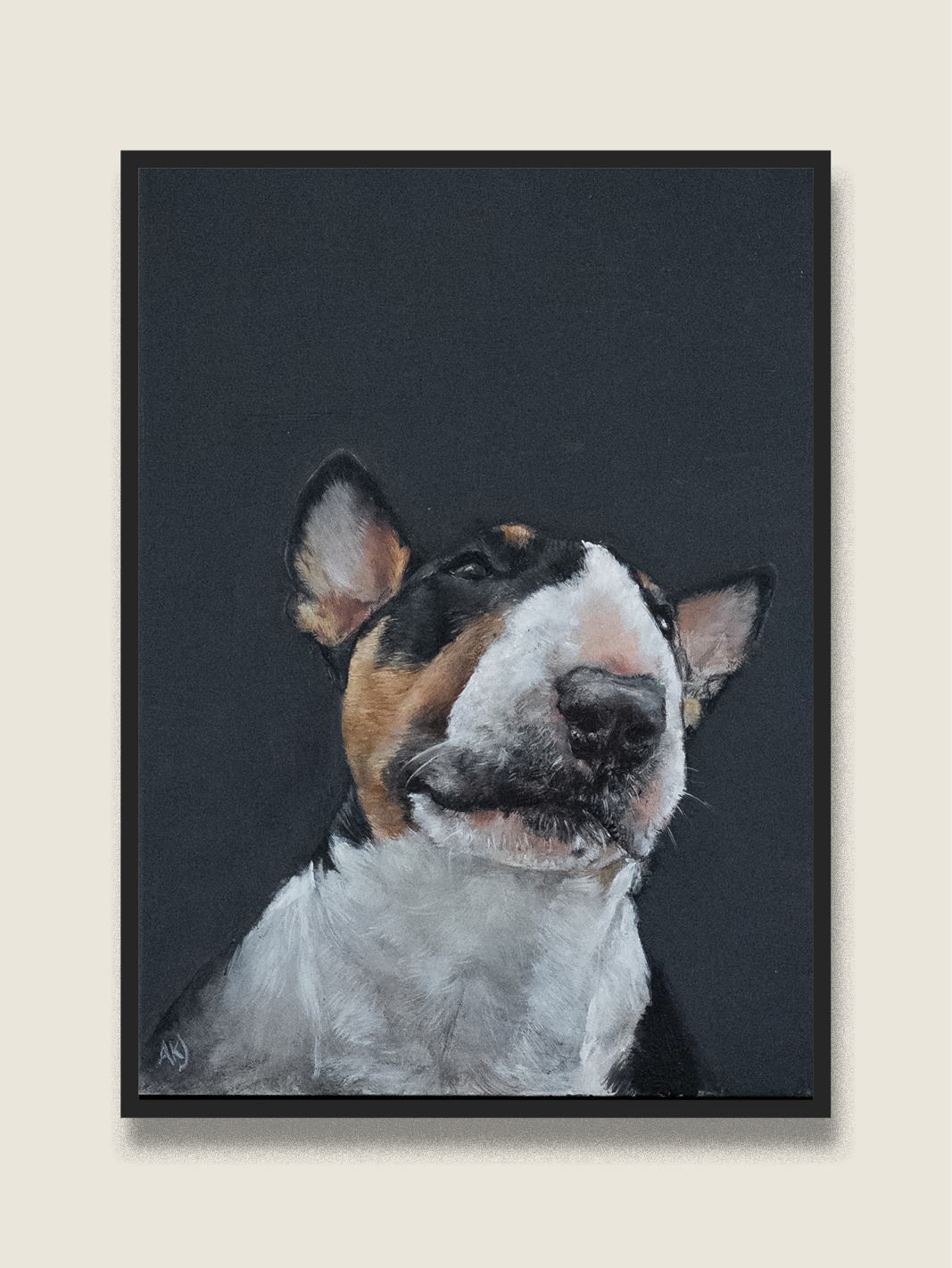
Bull Terrier
Oil on board
Dimensions: 22cm x 16 cm
ALISON JENKINS - Welsh
A painter of all creatures great and small
Born in Cardiff, Alison studied graphic design at Aston College Birmingham and went on to have a career in Graphic design at BBC Wales winning three BAFTA Cymru awards. The majority of her work is for individual commissions however in the last 5 years her paintings have been exhibited by the Royal West of England Academy in Bristol, Bath Society of Artists, Explorers Against Extinction shows in London and Edinburgh and the Wales Contemporary Art Show.
Alison's work is predominantly created using oil on board, her work is full of careful observation and detail and encapsulates the belief that small is beautiful.
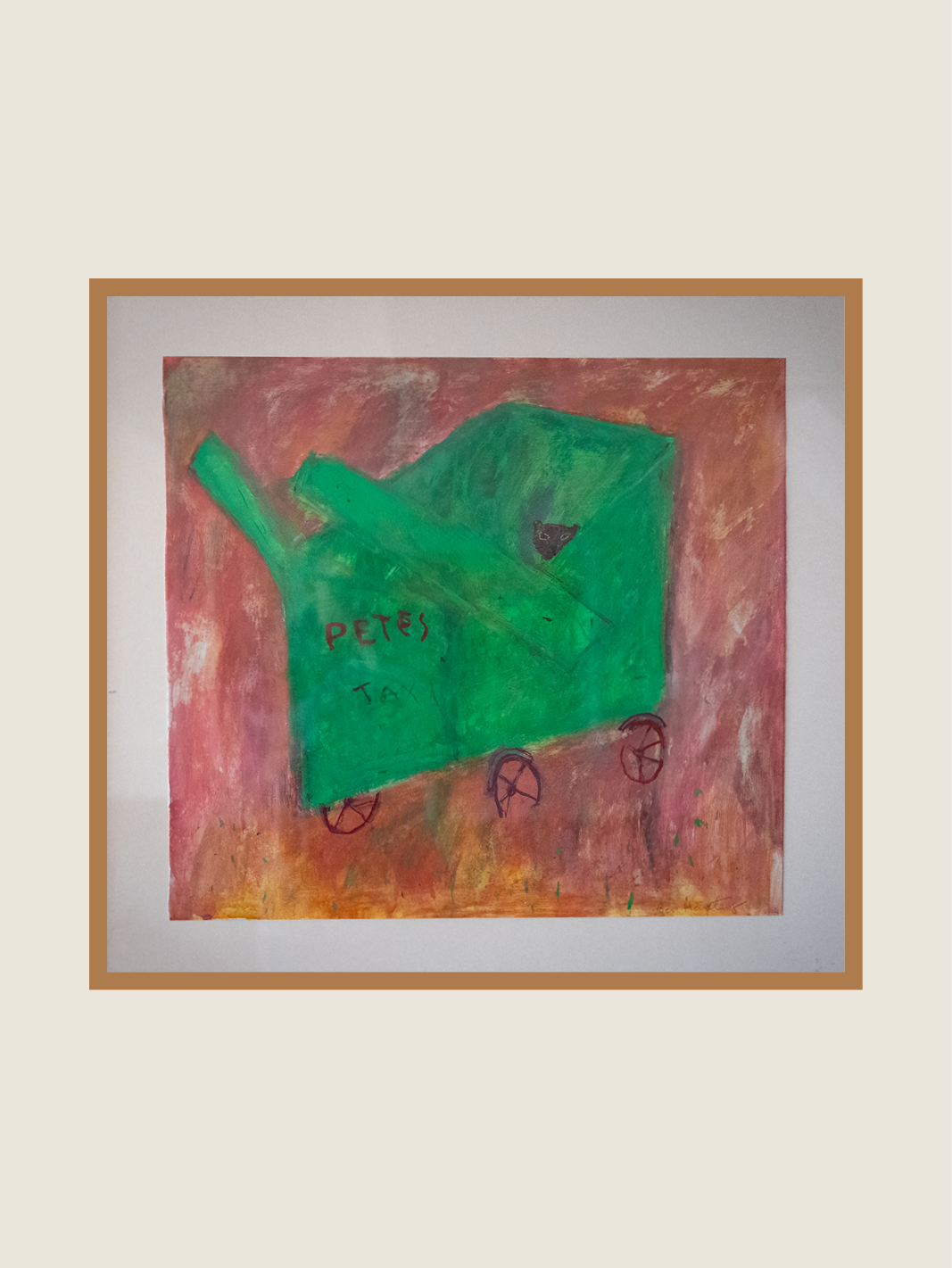
Express Agent
Gouache on paper
Dimension: 68m x 73cm
BEN HARTLEY 1933 - 1996
Born in 1933, Ben Hartley grew up in Mellor, on the edge of the Peak District. Ben was sickly as a child and drawing became a consolation – his grandparent’s farm close by offered an abundance of opportunity to explore and record country life. His experience there provided an understanding and familiarity with nature and memories from this time remained at the centre of his work throughout his life.
After studying in Manchester and then at the Royal College of Art in London, Ben lived and worked in Devon for 23 years, from 1960 when he taught part-time at Plymouth College of Art, until he moved to Presteigne, a small town on the Welsh side of the Border Marches.
Ben filled notebooks with drawings portraying country life as he found it with a distinctive humour that is now a widely recognised hallmark of the work. With an extensive knowledge of literature and poetry, and a passion for French post-impressionist work, he portrayed his unique and joyful vision that captured the observed ‘other’ of the natural world. His quirky and humorous observations later formed the basis of many of his paintings, all brimming with an affection for the wonders of the world around him.
He was a colourist, an abstract painter, and a superb draughtsman. His paintings describe the human condition with humour and compassion. His paintings show his appreciation and understanding of nature; with a countryman’s eye he recreates birds, butterflies, insects, dogs cats, farm animals and the people who live with them.
For enquiries about commissions or if you want to view some of the pieces in person, get in touch.